

Vermilion’s current airport opened July 9, 1976
The Province of Alberta built the new airport in a province-wide program to build airports at small towns to boost transportation and encourage business development.
They filled an old landfill site, built the new airfield north of the previous grass landing strips (what is now the Airport subdivision), built the terminal building, and paved the runway and apron. All levels of government were involved, as well as local business and community groups.
Aeradio moved into the new terminal building (see the article below).
The Province transferred the new airports to the towns at no cost.
Towns assumed responsibility for their airports, including operations, maintenance and upgrades.
Ownership of the property reverts back to the Province if it ceases to operate as an airport.
Opening day ceremonies
Opening day ceremonies included speeches from dignitaries, an airshow including acrobatic aircraft, a planned performance by The Snowbirds, helicopters and aircraft on static display.
The Vermilion Standard
Did you know?
1907 to 2005 editions of The Standard are stored on microfilm at the Vermilon Public Library.
Scroll down to see transcribed articles from The Standard before and after the July 9, 1976 airport opening.
Names are bolded, just for fun.
The first article (July 7, 1976) is mostly prior history of the airport, going back to 1931.
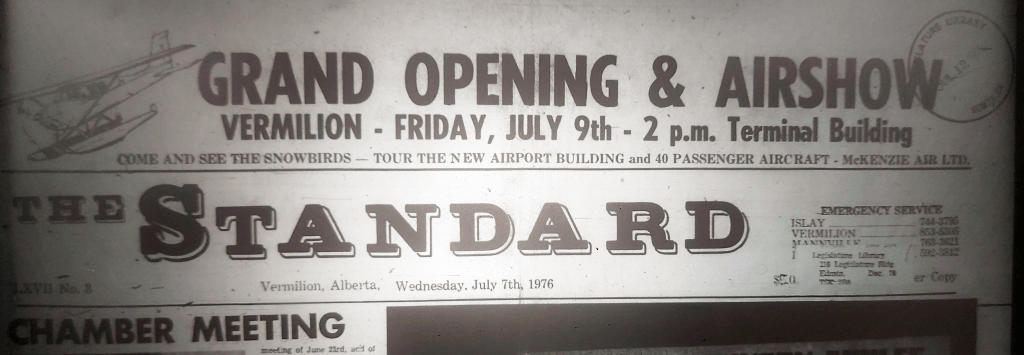
GRAND OPENING & AIRSHOW
VERMILION – FRIDAY, JULY 9th – 2 p.m. Terminal Building
COME AND SEE THE SNOWBIRDS – TOUR THE NEW AIRPORT BUILDING AND 40 PASSENGER AIRCRAFT – McKENZIE AIR LTD.
Table of Contents
Scroll down or click to go directly to an article:
- July 7, 1976 (before the grand opening)
- July 14, 1976 (after the grand opening)
- July 21, 1976 (the following week)
The Vermilion Standard July 7th, 1976
The beginnings of the airport date back to 1931. According to a 1946 article, town council set aside attractive land east of town for a future airport. Construction of two runways began in 1937. The reasons for such a decision are unclear but for a town of vermilion’s size at the time, it proved to be very foresightful.
During this early period a former local Vermilion resident would fly his tiger moth from Edmonton and land on an available field in the area. This early flyer was Maury Fallow.
Maury Fallow was a longtime manager of the Edmonton flying club and was nationally known for his interest in flying. His father was William Fallow, former mayor of Vermilion and Minister of Public Works during the war.
Planes were a new thing for many people. Maury Fallows trips to Vermilion would attract many people to inspect the aircraft and talk to the young pilot. These frequent air visits began an interest in flying in the area.
During the war years the Vermilion runaways were used by the R.C.A.F. is a training stop out of Edmonton. Aircraft were by then a common daily experience for residents.
1945 the Department of Transport placed the Aeradio units in Vermilion. This made the Vermilion airport unique for the size of the town. There was 2 strips to land on and radio contact could be used to help pilots in flight. The two runways were continually packed and in the winter were kept free of snow.
In 1946 the airport was licensed as a municipal airport. This was a first in the province.
After the war the interest in flying mushroomed. Ken Crowshaw and Wally Hooper operated a very successful Air School. Enrollment was good and the facility was excellent. The enthusiasm dwindled after a few years but many pilots were trained including some women.
The flying interest remained in a few hands. Early boosters were the Pilkies and Ken Rowe. These men remained active flyers.
During the 50’s men such as Gordon Allen continued to represent flying interest in the town. He installed a fuel tank to fuel his two planes. He also built a shed to house them. He was the main organizer of any Fly-ins that took place until the Chamber of Commerce took over.
The 60’s started out with little or no interest evidenced. Then, in 1961 Bob Snelgrove received his license to fly in Swift Current and then purchased a Piper Cub. This was the beginning of an upsurge in flying interests that culminated in 1968 with the formation of a flying club. Members of the club included Doug Livingstone, Andy Klarr, Ron Inman, Phil Pearman, Hans Henrichson, George Daugela and Bob Snelgrove.
This group disbanded in 1974. In 1975, with new members and the forthcoming airport, the Vermilion Valley Flyers was formed.
It was also during this upsurge of flying interest in the late 60’s that Town Council realized that the existing airport would need to be upgraded. There was a possible threat that the Aeradio Station may be moved elsewhere. Council decided to act and the Vermilion Airport Committee was formed out of different groups who had an interest in the Airport.
From this committee and the support of the town in general the present new airport facility evolved.
The Vermilion Standard July 14th, 1976
Friday afternoon an estimated 3000 men, women and children gathered at the site of Vermilion’s new Airport to witness the official opening.
The ceremony was the culmination of years of hard work by many citizens who generously donated time and energy in doing the unlikely.
It is difficult to imagine the amount of work involved in coordinating 3 levels of government, community and private interest into a workable union. Still the men and women who organized themselves for the purpose of keeping the Vermilion Airport in Vermilion ignoring the odds and the skeptical attitude of fellow townsmen, proved that it could be done, Bravo.
The airport is here to stay. It is a fact of Vermilion’s life. Now the real test of Vermilion’s sincerity will be measured.
John Walker, Caucas [SIC] Chairman of the Airport Committee in his remarks of the opening ceremonies hinted at the possible future that awaits Vermilion. Today, a town without an airport is like a town passed by the Highway 50 years ago or a town passed by the Railway 100 years ago.
Vermilion with a modern facility in aviation will be available to use aviation opportunities and hopefully use them wisely.
Vermilion with the new airport is keeping pace with the rest of the world.
Dr. Schmidt, provincial minister without portfolio, Don Dewar Western Regional Administrator M.O.T. and Mayor Jack McLean, cut the ribbon to officially open the new airport. These three gentlemen represented the 3 levels of government that co-operated in the upgrading of the new facility.
Previous to the official ribbon cutting the ceremony began at approximately 2 p.m. with the singing of O Canada.
Councillor Floyd Sweet open with a few introductory remarks. An introduction of guests in their representative capacity in attendance at the function was conducted by M.C Sweet.
Mayor Jack McLean then welcomed one and all on behalf of the Town of Vermilion. He emphasized that for growth and development, a community needs good connections in transportation and communication. With air travel, Vermilion was meeting this need.
Tom Lyons then spoke. He congratulated the efforts of those involved in the planning construction and completion of the new airport. He made special mention of Lloyd Seath George Daugela, Floyd Sweet and Angus MacMillan for their endeavours. Also the Vermilion Standard (1973) Ltd. For the Special Edition on July 7th.
M.P. for the area Don Mazankowski, then brought greetings from Ottawa.
In view of this event, the message M.P. Mazankowski stressed concerned the co-operation of the different levels of government and people at the community level in illustrating what could be done. In his words, it was a significant occasion. It was not an easy decision to undertake but it was a step forward and he was impressed.
Angus MacMillan of behalf of the Vermilion Airport Committee expressed thanks to the various groups and individuals who helped create a dream into reality.
Lloyd Seath then delivered a few words. He thanked George Daugela for unlimited assistance and encouragement, Bill Baranyk for his influence in the top levels for the use of the PEP program in the Airport construction, and the Alberta Road Builders Association for sponsoring the program were included in Mr. Seath remarks.
Walt Stefaniuk, Regional manager of M.O.T. then congratulated the efforts of Vermilion and informed the crowd that because of the new facility better service would be provided for air activity and the general public. He invited everyone to tour the Aeradio facility in the Terminal.
As mentioned, John Walkers remarks shed light on the significance of the Airport. He also informed that it was the Alberta Governments intention to build similar airports throughout Alberta. It is the Government intention to build, the running if it is up to the people at the district level.
Don Dewar brought greetings from Otto Lang. In his capacity representing the Federal Government he congratulated the efforts of the 3 levels of Government and the Town for the fine job done.
Dallas Schmidt then addressed the crowd. He pointed out the necessity of having an all weather airport in a rural committee. He hoped that the facility would be used for pleasure, business and commercial use by everyone,
Father Purcell representing the Vermilion Ministerial Association then lead [SIC] a prayer and blessed the Airport.
The air show started out with A. E. Seitz in his Chipmunk doing an assortment of aerobatics. The Chipmunk is not the regular plane used for a show. Engine trouble had forced its use. The carburetor of the Chip is not geared to going upside down. The competent Seitz still managed a fine display of Aerobatics even when the engine would conk out from a flip.
Valere Roy then gave a demonstration of a Helicopters ability. This airborne machine whizzed through the air, would stop and then speed off with little hesitation. The R.C.M.P. twin Otter provided folks with a fine display of flying with only one engine and the short take off. The awkward looking big bird proved a handy aircraft with a runaway display of backing up. Throughout the day people were allowed to browse through the different helicopters and aircraft on display.
The Vermilion Standard July 14th, 1976
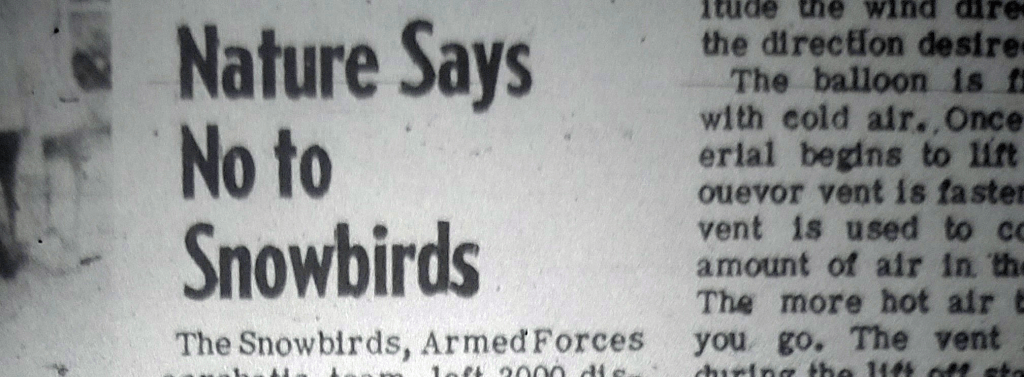
The Snowbirds, Armed Forces aerobatic team, left 3000 disappointed air show fans without a main event. Atmospheric conditions was the cause of their absence.
The afternoon had progressed nicely for air show activity. The official ceremonies for the airport opening had gone off according to schedule the warm up aerobatics had people ready for one of the most professional air shows around.
Unfortunately thunderhead clouds (Cumulus Nimbus) were within a 50 mile vicinity of the Vermilion airspace. This cloud activity is unpredictable and therefore unsafe for the type of show the snowbirds were to perform.
The Vermilion Standard July 14th, 1976
Saturday evening Vermilion was paid an aerial visit by 1 of 12 hot air balloons operating in Canada. For those who had not gone to the lake the 56,400 cubic foot, 50 ft. diameter by 70 ft. high light brown balloon was an attraction very hard not to notice.
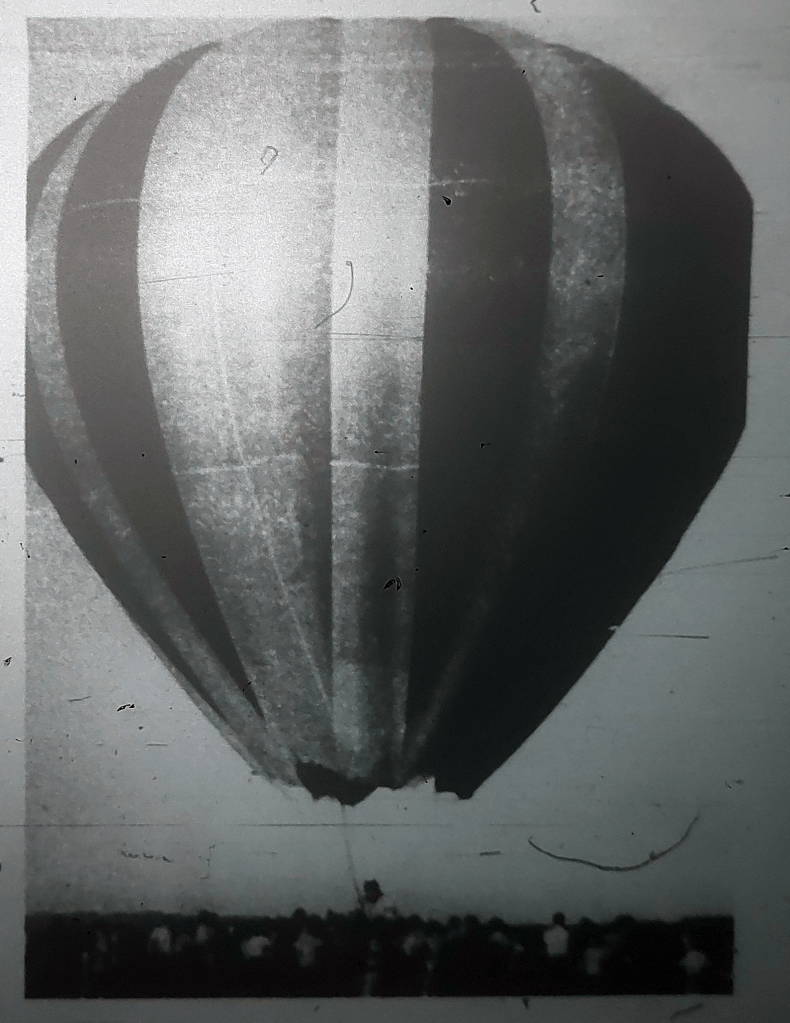
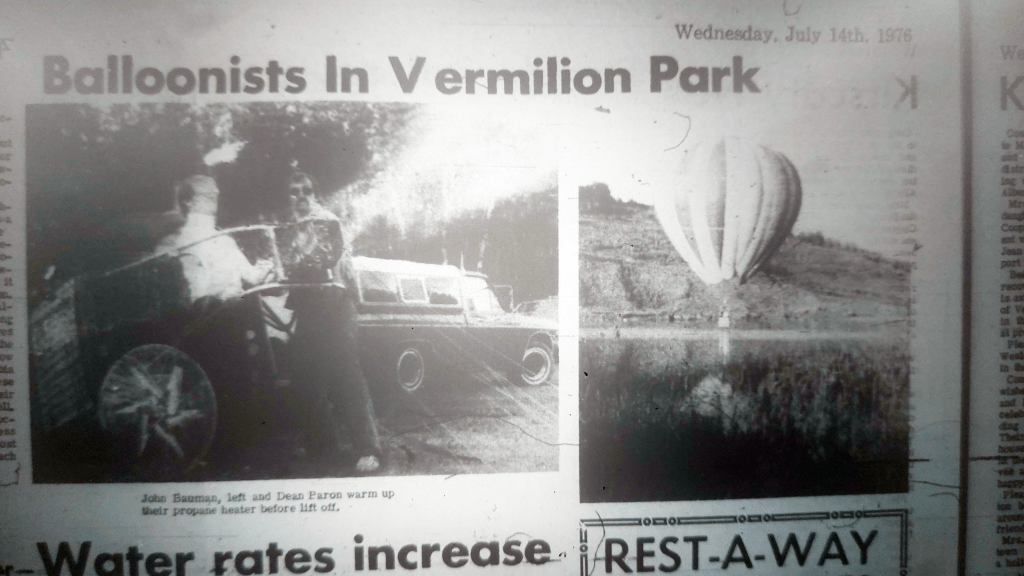
Balloonists John Bauman and Dean Baron were on their way back from Moose Jaw where they were giving rides and informing people of their sport. They decided to fly over Vermilion. John used to live in Buffalo Coulee where his father taught school. The night was right so he and Dean decided he would like to see Vermilion from the air.
They lifted off from the Provincial Park at the camp kitchen next to the ball diamond. By that time a small crowd had gathered. Within 15 minutes of unraveling the nylon ripstop material, they were airborne.
They floated over the Vermilion lake, dropped to within a foot of the water to talk to some people in a canoe, then sailed high into the sky along the river valley and landed just west of the runway of the Vermilion Airport. The landing was registered as the first for the airport.
Once landed a crowd of roughly 100 interested people rushed up to get a look at the balloon and crew.
John has had his balloon to 10,000 feet but prefers to sail anywhere from 200 to 1500 feet.
The balloon goes where the wind blows. The skill of the pilot is to find at what altitude the wind direction is to the direction desired.
The balloon is first filled with cold air. Once the material begins to lift the maneuver vent is fastened. This vent is used to control the amount of air in the balloon. The more hot air the higher you go. The vent is closed during the lift off stage.
The top of the balloon is also checked. First the deflate hole is fastened. When the balloon is to land for good this whole top piece can be pulled away to let all the air out. Second, heat indicators are checked to make sure the material has not been overheated. 250° will not affect the material but the indicators register and will warn the pilot.
After checking hot air is blasted into the balloon from propane tanks that provide a great deal of heat. The hot air sucks in more air. Another dose of hot air is pumped into the balloon. More air from the outside is sucked in. This process is repeated until the balloon is full and erect. All that is required for liftoff is another blast of hot air.
Basket weighs about 400 lbs and two or three passengers can be carried. The balloon is a registered aircraft.
N.P. Ballooning is a pleasurable pastime. What we have gained in speed we have lost in romance.
Bonus article: Vermilion Lake Swimmable!
The Vermilion Standard July 14th, 1976
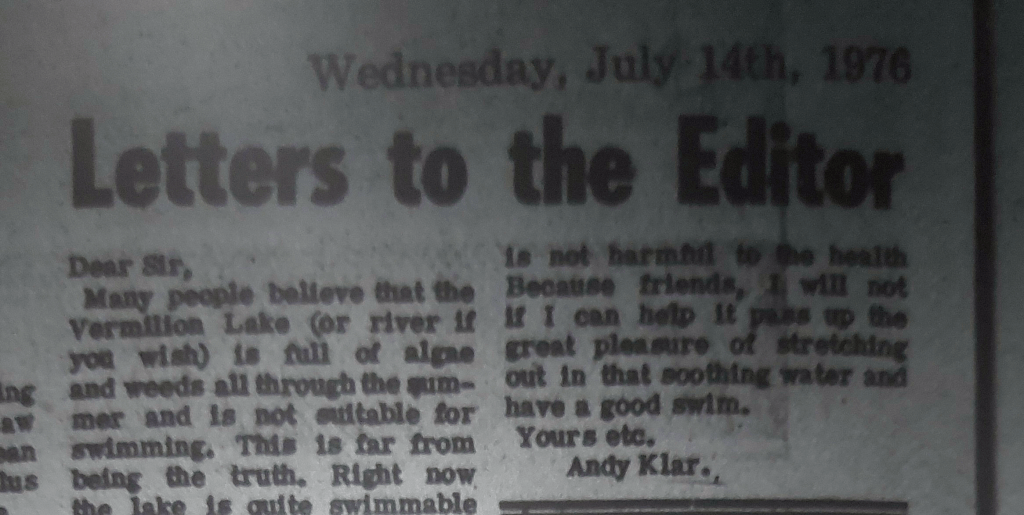
Letter To The Editor: Vermilion Lake is Swimmable
Dear Sir,
Many people believe that the Vermilion Lake (or river if you wish) is full of algae and weeds all through the summer and is not suitable for swimming. This is far from being the truth. Right now the lake is quite swimmable and the bathing areas are practically free of weeds. If the summer is warm, plants do build up by the middle of Aug but there is no reason for not using this vine recreational facility now.
The darker colour of the lake water is due mostly to the iron in the stream bed and it is not dirt, in the ordinary sense. One thing I can vouch for the Vermilion Lake is much warmer than the other lakes around us.
If you are worried about the quality of the water you can lay your fears to rest. The public health officer has had the water tested every year and he found it safe, to drink and to swim in. I myself am living proof that the water is fine. Until you see my name in the obituaries, you can assume that the Vermilion Lake is not harmful to the health. Because friends, I will not if I can help it pass up the great pleasure of stretching out in that soothing water and have a good swim.
Yours etc.
Andy Klar
The Vermilion Standard July 21st, 1976
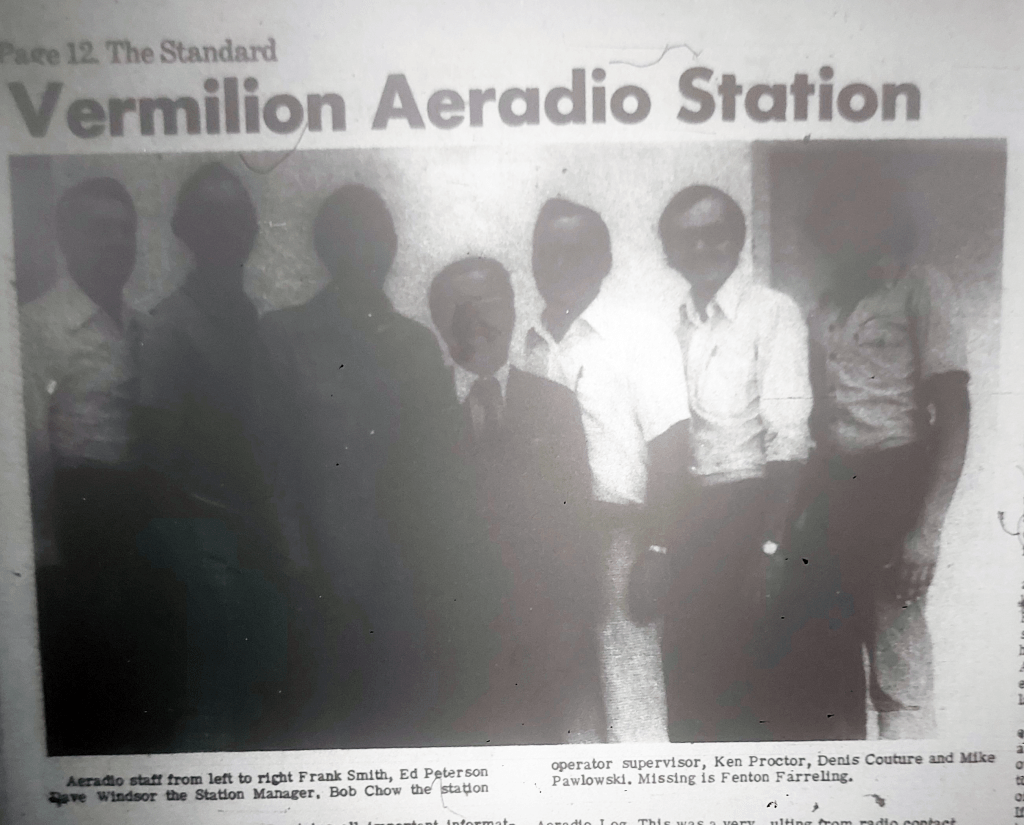
Aeradio staff from left to right Frank Smith, Ed Peterson, Dave Windsor the Station Manager, Bob Chow the station operator supervisor, Ken Proctor, Denis Coutoure, and Mike Pawlowski. Missing is Fenton Farreling.
AERADIO SCHOOL
July 13 and 14 Ed Haines area operation supervisor of Transport Canada conducted a VFR flight services course to the operators of the Vermilion Aeradio staff. The course is part of Transport Canada’s modernization program.
Ed explained the operation of the new Positive Airport Advisory. The advisory maintains all important information regarding aircraft activity in the Vermilion area. The Advisory is part of the improvement in aircraft service made possible with the new equipment at the airport terminal.
AERADIO TAPE LOG
Until recently all information regarding aircraft activity had to be typewritten into the Aeradio log. This was a very time consuming process. With the recent upsurge in aircraft activity in the Vermilion area a change in operations became necessary.
Now, all operations at the Aeradio office will be recorded by a 4 channel tape recorder thus freeing the operator from the typewriter. The new installation is more streamlined and safe in providing Aeradio services.
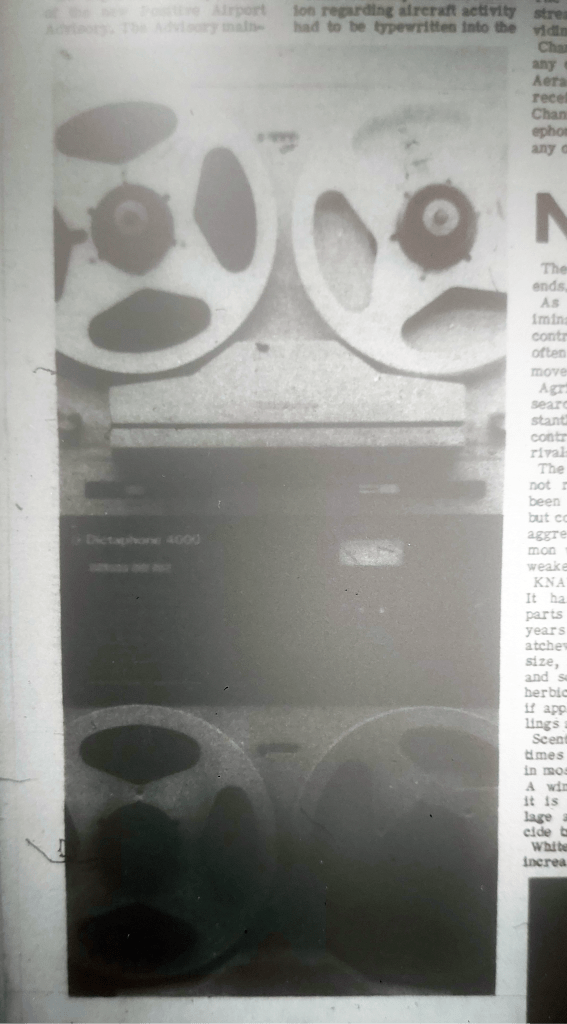
Channels one and two tape any communication between Aeradio operators and pilots receiving or transmitting. Channel three records all telephone communications and any other communication resulting from radio contact.
Channel four is the time channel. The tape continually registers the time. If a call has to be checked out the time channel will have been inserted into the tape giving the operators the exact time of the call.
The tapes are changed every 24 hours.
If the taperecorder should fail to operate the bottom two tapes are automatically programmed to take over. The failure of the regular tapes registers on the control panel in the operations room period
The new Tape-Log is a safety plus. It protects pilots and Aeradio operators.
The Vermilion Standard July 21st, 1976
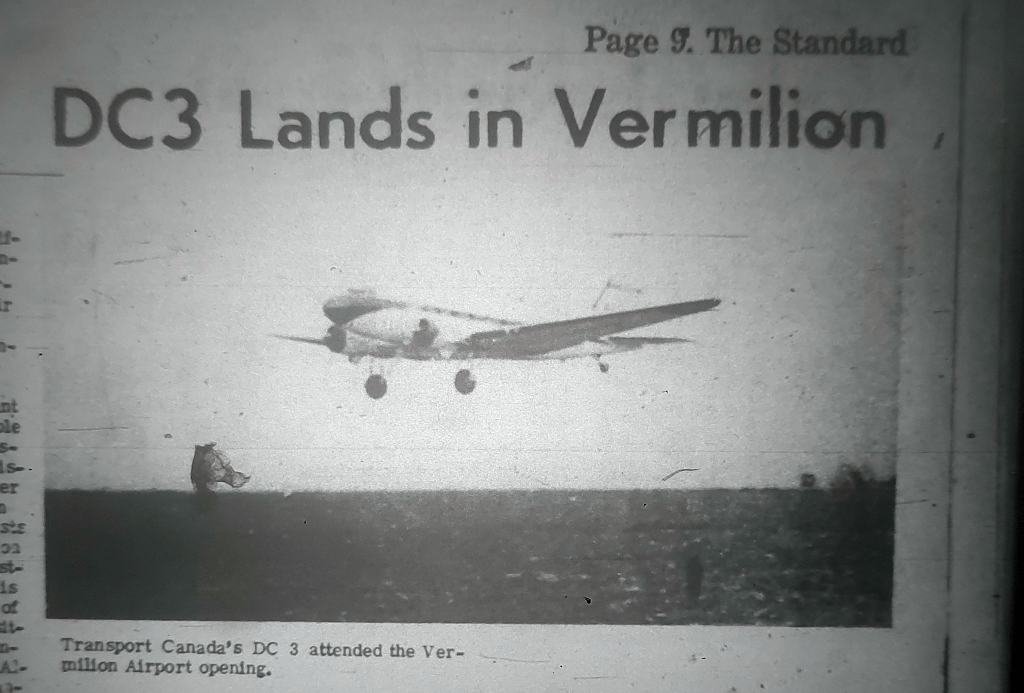
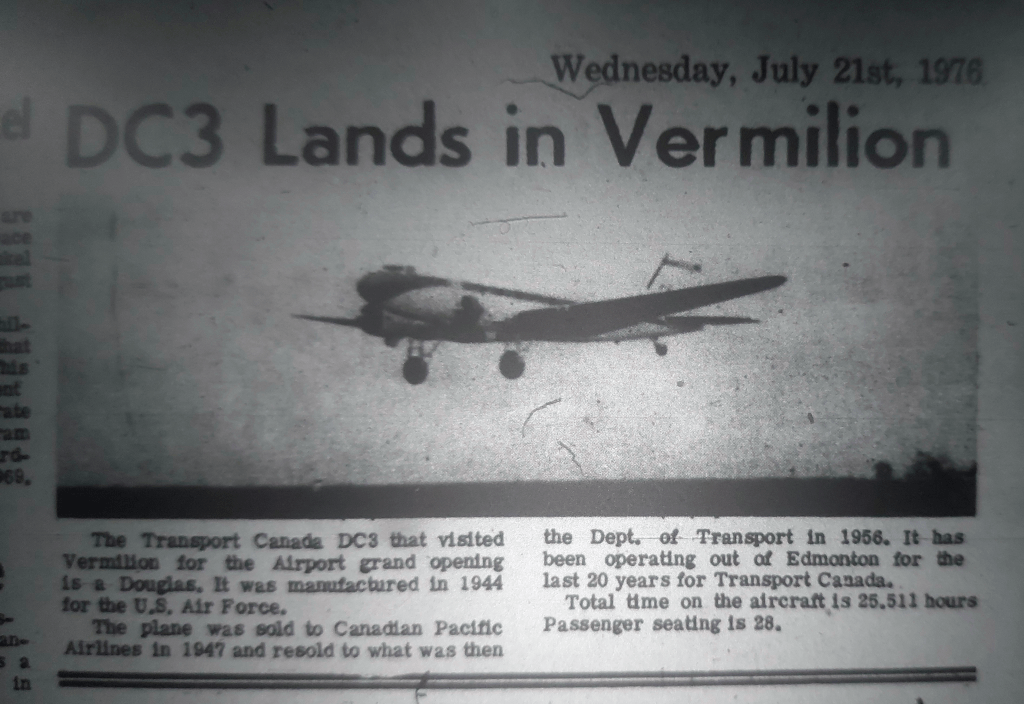
The Transport Canada DC3 that visited Vermilion for the Airport grand opening is a Douglas. It was manufactured in 1944 for the U.S. Air Force.
The plane was sold to Canadian Pacific Airlines in 1947 and resold to what was then the Dept. of Transport in 1956. It has been operating out of Edmonton for the last 20 years for Transport Canada.
Total time on the aircraft is 25,511 hours
Passenger seating is 28.


Leave a Reply